

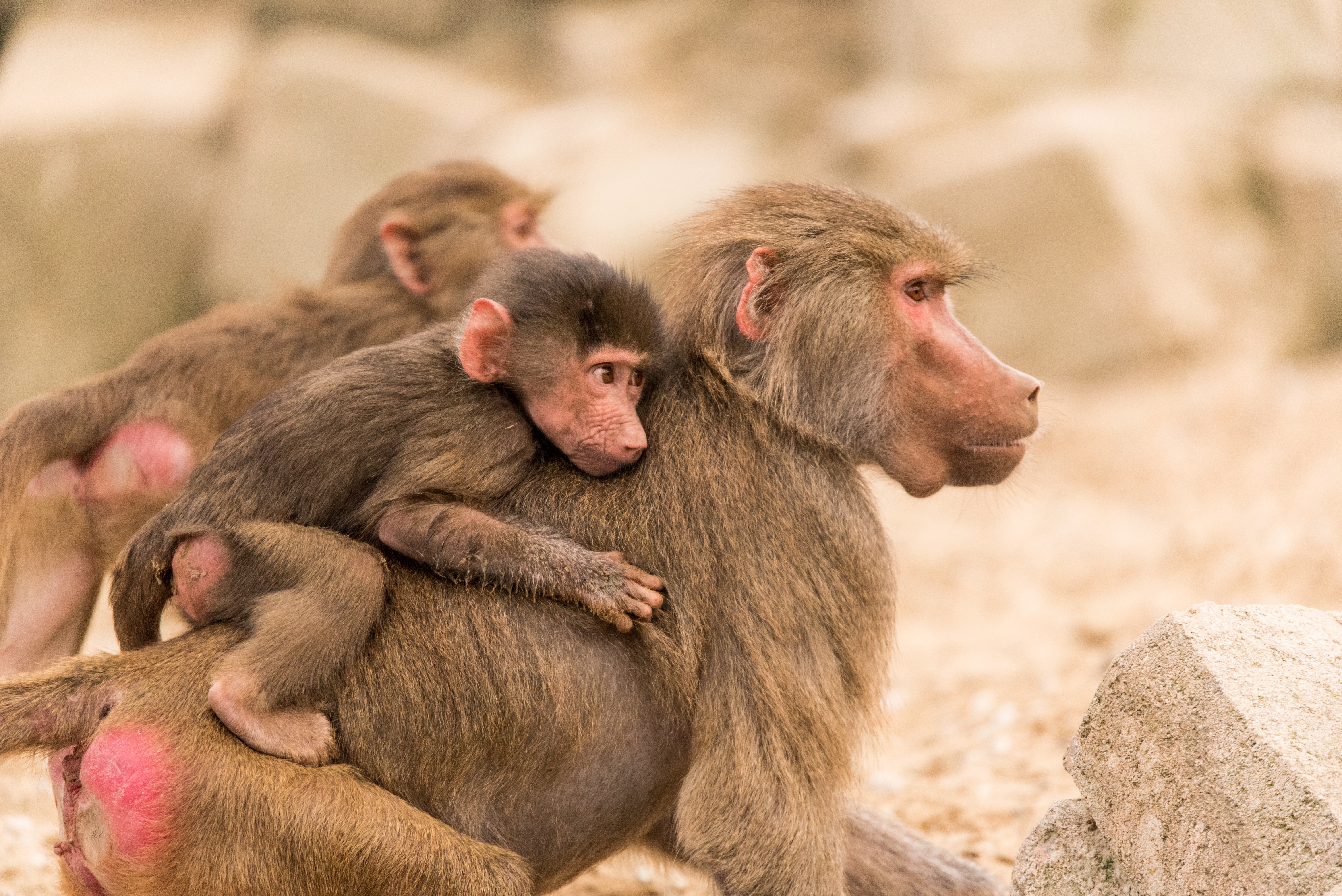
Baboons are the World’s Largest Monkeys

When we watch forest primates climb through trees, howl and eat insect larvae, it’s easy to overlook the fact that we share _____1_____ of our DNA with them. Despite being our kin in the tree of life, humanity has not been kind to baboons, some of the most intelligent primates on Earth. Native to the rainforests and savannas of Africa, baboons have taught us a lot about what it means to be a primate in a world dominated by humans. Clearly intelligent and socially advanced, there are more similarities between humans and baboons than there are differences. Tragically, we humans are the greatest threat to the survival of baboons. If this fellow primate is to survive in tomorrow’s world, we must learn to value and protect the baboons and their way of life.
Baboon Diversity
Baboons are large, intelligent primates native to much of Africa and the ______2______ Peninsula. This group of monkeys belongs to the Papio genus of the Cercopithecidae family in taxonomic classification of life. More commonly known as the ______3______ Monkeys, the Cercopithecidae are the largest family of primates with 138 species. The taxonomists who study relationships between species have not come to a conclusion regarding the baboon family tree. Although a minority of taxonomists believe most baboon species should all be considered one species, most taxonomists recognize five distinct species:
The ____4_____ baboon (Papio cynocephalus) is the widest-ranging baboon species. It lives in 25 African countries from Mali in West Africa to Ethiopia and Tanzania in East Africa.
The ____5_____ baboon (Papio cynocephalus) lives in East African forests and savannas. It’s Latin name means ‘dog-headed’, a reference to the physical similarities between this baboon and canines.
The Hamadryas baboon is the northernmost species of baboon. It lives in the arid deserts of the Horn of Africa in the nations of Eritrea, Ethiopia, Djibouti and Somalia. Across the red sea, they also live in southwestern Arabia, in both Yemen and Saudi Arabia. The ancient _____6_____ revered this species as sacred, and to this day it is also known as the sacred baboon.
The Chacma baboon (Papio ursinus) is found throughout southern Africa in the countries of Angola, Botswana, Mozambique, Namibia, South Africa, and Zambia. It’s the ______7______ baboon. It weighs up to 100 pounds and has a body length of up to 45 inches, tail not included.
The Guinea baboon (Papio papio) lives in West African rainforests. Unlike other baboons, it’s not a very good rock climber and tends to live in _____8_____. This is the smallest of the baboons, weighing only 30 to 60 pounds.

Baboon Ecology and Behavior
Baboons are _____9_____, opportunistic eaters. They’re always searching for sources of protein and nourishment, but they’ll eat just about anything they come across. Their preferred foods are fruits, roots, tubers, grass, seeds and leaves. They also will eat insects, worms, spiders, crustaceans, small mammals and small birds.
All baboons are sexually _____10_____, meaning that obvious physical differences exist between males and females. Females are smaller and less violent than males. Baboon societies are a _____11______ social system in which most social interaction occurs within small groups called harems. Each harem contains one male and up to _____12_____ females, which the males lead and guard. Harems meet up with others from time to time to form a clan. Male leaders in the clan are often related, and older males rule the clan. Two to four clans travel and sleep together in a larger structure called a band. Some bands contain up to 100 baboons. When bands come together, they form a troop. Troops most often congregate near sleeping cliffs.

Threats to Survival and Conservation
International conservationists are working hard to address the two largest threats to the survival of baboons: habitat loss and human activity. Baboons are hunted for their _____13_____ and poisoned in areas where they are considered _____14_____. They are even used in some medical research due to their similarities with humans. Every year, baboons lose habitat due to cattle grazing, irrigation projects, and human settlement. But fascinating research shows that humans and baboons prefer the ______15______ habitat in Africa. This means that complaints of nuisance baboon populations in urban Africa are simply because of an overlap in suitable habitat. We want to live in the same environments that they do. Understanding this is key to a better future for persecuted primate populations. Public education efforts are the most promising chance to create a world where humans and baboons live side by side in peace. After all, we are primates too.
