

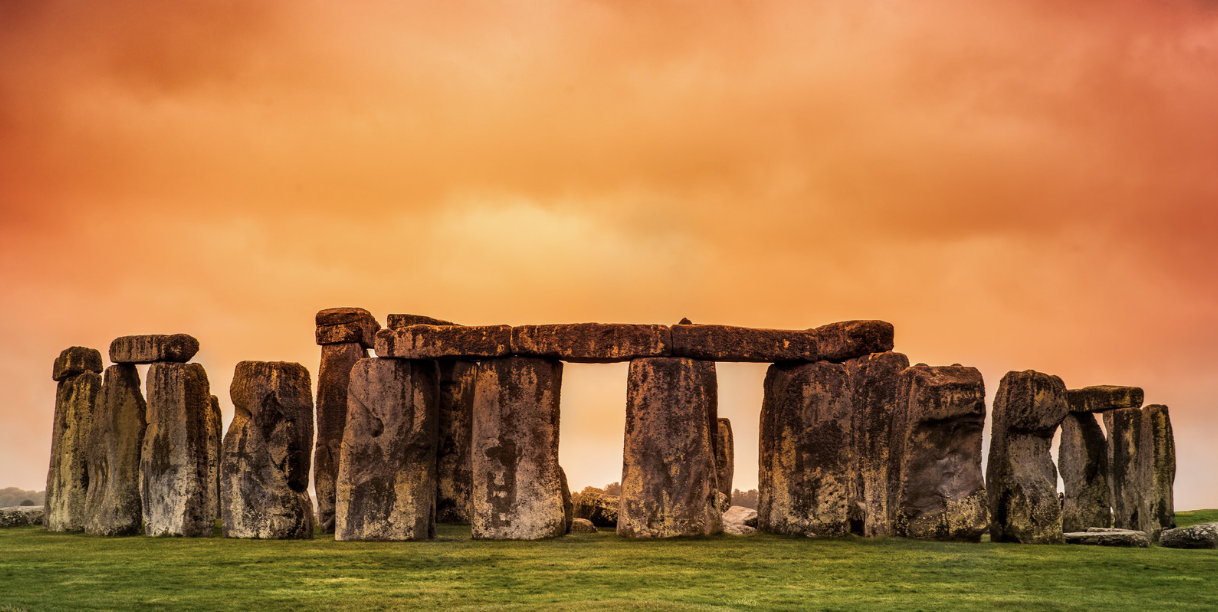
Stonehenge: The Mystery Behind One of the Oldest Man-Made Structures
Stonehenge was built in the ____1____ period around 2000 – 3000 B.C. Archaeologists label henges as earthworks with a circular bank that is enclosed with an internal ditch. As Stonehenge’s bank is inside the ditch, it is, in fact, not a henge!
This is not the only way that Stonehenge is atypical. It was built with mortise and tenon joints before erecting the stones. This is one of the strongest joint connections, and is created by hollowing out a mortise hole and creating a tenon tongue that fits the hole precisely. When two stones are erected vertically with a stone lintel, it is called a ____2____.
The builders used tools made out of animal bones. The ground was dug with ____3____ and cattle shoulder blades were used to shovel the earth. Enormous stones were carried miles by rollers, sledges, and rafts.

Charcoal was found at a camp at Blick Mead about 1.5 miles east of Stonehenge that dates back to 4000 B.C. Archaeologists believe that the group that built Stonehenge lived in the area for several millennia. The Stonehenge Cursus, also known as the Greater Cursus, was made around 2,300 feet north about a thousand years before Stonehenge. Two miles away, there is indication that there were ‘builders camps,’ which suggests that as many as 4,000 people would have come to Stonehenge twice a year at mid-winter and mid-summer for ____4____.
Archaeologists break up the creation of Stonehenge into three parts: Stonehenge I, Stonehenge II, and Stonehenge III.

Stonehenge I began around 3100 B.C. A circular earth bank and ditch approximately 360 feet in diameter were created. There are 56 ____5____ that encircle the outer edge of the enclosed area, about 3.3 feet in diameter each that were thought to hold wooden posts of an igneous rock called bluestone.
During Stonehenge II, around 2150 B.C., the posts were removed from the Aubrey Holes and partially filled with cremation deposits and soil. A team of archaeologists led by Mike Parker Pearson found evidence of cremated bone fragments from 63 individuals thought buried there. William Hawley had previously led an excavation and deemed these fragments unimportant. He originally found them individually buried amongst the Aubrey Holes, but later reburied them together, in what is labeled Aubrey Hole 7.
A recent study has found that the people who were cremated did not necessarily live near Stonehenge; the genealogy puts them closer to the Preseli Hills, known today as Pembrokeshire in Wales, where the bluestone originally came from. Because of the cremation remains and the timber found at the northeast entrance, it is interpreted that Stonehenge had functioned as an enclosed cremation cemetery. This would make it the British Isles’ earliest known ____6____.

Stonehenge III was constructed around 2000 B.C. About eighty enormous Oligocene-Miocene sarsen stones, or sandstone blocks, were brought from 16 miles away. They could measure up to 30 feet long and weigh 50 tons! They created mortise and tenon joints on each stone before placing them in the ground and lintel stones rested above them in a ____7____ -foot diameter circle. The lintel stones were curved slightly to keep the circular appearance from earlier phases. These enclose a horseshoe formation of five large trilithons. 20 bluestone from Stonehenge II were erected into an oval shape inside, but was not well constructed. It was later taken down and a ____8____ of bluestone took its place, and still stands today.
There are many myths that surround Stonehenge and its use due to the lack of ____9____. A natural landform at the monument that aligns with the midwinter and midsummer solstices could possibly have inspired its creation. When bluestone is hit, it makes a sound! “____10____” were believed to having mystic or healing powers. Due to the evidence of dozens of cremations and burials as well as the deformities found in the remains, another theory is that it was a place of healing or was a religious gathering area. Whatever purposes Stonehenge may have been used for, its design invites celestial observation, which might have allowed them to predict eclipses, solstices, equinoxes, and other events.
