

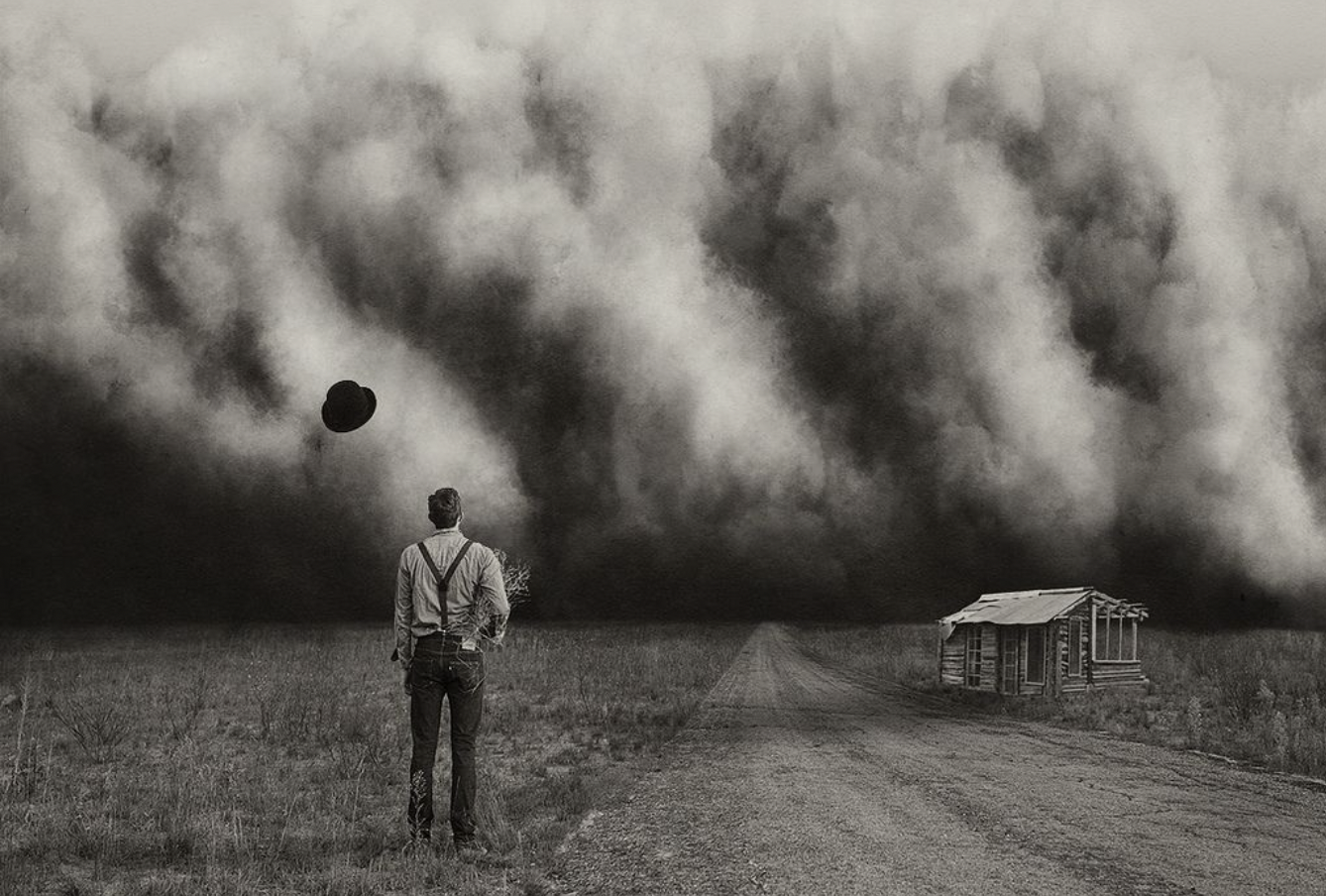
The Natural Disaster Caused by Inexperienced Farmers

After the Civil War, farmers were incentivized to move to the Great Plains. The Homestead Act of 1862 followed by the Kinkaid Act of 1904 and the Enlarged Homestead Act of 1909 brought droves of new farmers to the area that had little to no experience. Americans believed in ____1____, that they had a duty to expand west. A superstition of the time that the “rain follows the plow” led to the belief that by working the semi-arid land, farming endeavors would inherently be successful.
The farmers raised ____2____ and plowed the land to plant dry crops like wheat. During World War I, wheat prices increased along with the demand. Farmers plowed millions of acres more and reduced their cattle herds to plant these row crops. Soon after, the ____3____ hit. The record amount of wheat that was being produced caused the price to plummet in the economic disaster. Farmers struggled to make a profit in the oversaturated wheat market and many attempted to recoup their losses with a bumper crop, a crop with an unusually high yield. They plowed additional land for these crops.

The ____4____ hit in 1930. Farmers had torn up the prairie grass, which held deep roots, for their crops, and their cattle overgrazed the area, which caused the soil to loosen. The regional winds were strong and it blew the loose soil away, which produced massive dust storms. By 1934, 35 million acres of farmland was effectively useless and 125 million more acres was quickly losing its topsoil. This drought was not the worst that the region had seen, but it was a combination of this current drought and poor ____5____ practices, added to unusually high temperatures, that created the wind erosion which amplified the damage.
About 2.5 million people migrated during the Dust Bowl, many of them moving west. Oklahoma alone lost 440,000 people to this migration, and about 85,000 of them went to San Joaquin Valley, which was agriculturally rich. The amount of migrants looking for work quickly surpassed the amount of available work. All of these unwelcome Dust Bowl refugees, regardless of state of origin, were dubbed “____6____” by the locals. They faced discrimination and most could only find work menial labor work with awful wages. John Steinbeck wrote about the migration in ____7____, published in 1939.

These dust storms were often called “____8____,” and could carry soil from these areas as far as Washington, D.C. and New York City. They often lasted days at a time and in some places, residents had to remove the dust with shovels like snowfall. Dust would get into every crack of even the most well-sealed building and leave a layer of dust on food, skin, and furniture. “Dust pneumonia,” presented with chest pains and difficult breathing, took an unknown amount of lives, estimated between hundreds and several thousands.
The storms increased yearly until its peak in 1935. In 1932, there were 14 dust storms. 1933 had 38. 1934 had approximately 100 million acres of farmland swept by the wind. May 11, 1935 brought a terrible storm that was ____9____ miles high and made monuments like the Statue of Liberty and the U.S. Capitol unobservable. The next year on April 14, the worst storm, coined Black Sunday, hit. An estimated 3 million tons of topsoil blew off the Great Plains that day, blowing east from the ____10____.
Between 1933 and 1935, President Franklin D. Roosevelt helped put measures in place to assist the affected farmers, and addressed what caused the dust storms in the first place. In 1935, the Soil Erosion Service and the Prairie States Forestry Project was established, which gave the local farmers work in the way of planting trees in the Great Plains to act as windbreaks. They also implemented new techniques to combat soil erosion to help prevent a similar disaster. This program is now called the Natural Resources Conservation Service (NRCS).
Rainfall returned in 1939, but many of the counties where the soil failed to recover saw population declines until the 1950s. An estimated 90% of the 450 million hectares (1 hectare = 100 acres) suffers from moderate to severe desertification.
