

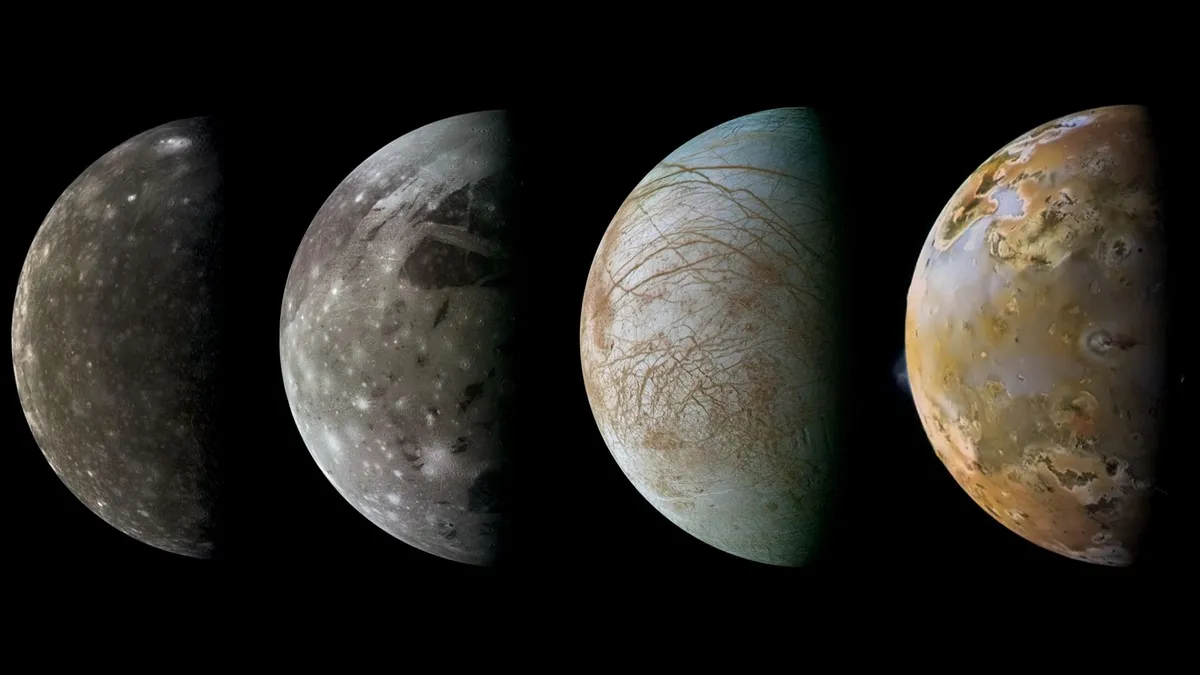
Exploring the Many Moons of Jupiter
The largest planet in our solar system is Jupiter. It’s the fifth planet from the Sun and is more than twice as big as all the planets combined! Scientists estimate Jupiter to be 318 times bigger than our planet Earth. While Earth has only one moon, Jupiter has a whopping 79 moons.
On July 16, 2018, astronomers discovered twelve new moons around the planet, most of which are still unnamed. Out of the 79 moons, only _____1____ have been named. The only other planet that has more moons is ____2____, which in late 2019 passed up Jupiter with 82 moons. Jupiter had been the planet with the most moons since the late 1990s.

The moons are also called satellites, which is the definition for anything that ____3____ around a larger object. While most people think of satellites as human-made objects floating around in space, a natural satellite, which the moons are, is considered any _____4____ body that orbits around a larger body in space. Moons orbit planets, so they are called natural satellites.
Jupiter has many interesting moons, but the ones that scientists have found to be the most interesting are the _____5_____ satellites. These satellites were named after the _____6____ astronomer Galileo Galilei who first observed them in 1610 and were the first ____7_____ moons ever discovered beyond Earth. A German astronomer named Simon Marius reported having seen the satellites around the same time but failed to publish his findings, so Galileo was given credit for this discovery. These enormous moons each have unique characteristics and distinctions and are called lo, Europa, Ganymede, and Callisto.

Io (or i.o.) is the most ____8_____ active body in the solar system. The surface is covered in ____9_____ with colorful lava lakes and liquid rock, with 190-mile plumes of sulfur shooting upward. There are about 150 volcanoes on the moon, with new hotspots occasionally popping up. Some of these volcanoes are capable of blasting lava 250 miles into outer space.

Europa is the most intriguing to astrobiologists because the satellite has the potential of having a “habitable zone.” Unlike Io, Europa’s surface is covered in ____10_____, and scientists believe there may be an ocean beneath the surface. That is where the habitable zone could be. Since Jupiter always _____11_____ the surface of Europa, life could not survive on the surface. But the radiation could possibly create fuel for life underneath the icy crust. It is believed that this moon has ____12_____ as much water as Earth.

Ganymede is the only moon with its own magnetic field and the largest moon in our solar system. This magnetic field causes ____13_____ that are ribbons of brilliant, electrified gas, making quite a show for astronauts in space. This satellite also may have an ocean underneath its icy surface, which could be another possible habitable zone. In 2030, the European Space Agency is planning a mission to Jupiter’s icy moons to investigate if that is a real possibility.

Callisto has an ancient, _____14_____ surface and is considered to be a dead moon by some. But it is believed there is also an ocean beneath the “dead” surface, and much more research needs to be done to quantify this. Another question that scientists have is if there is an ocean, could it sustain life? They are not sure since the surface is so _____15____.
Astronomers, biologists, researchers, and scientists are continually evaluating the satellites of Jupiter. Pictures are being taken from space, astronauts are doing fly-bys with their spacecraft, and astronomers are even accidentally discovering new moons while searching the outer parts of the solar system for other planets. Who knows, in the not so distant future, Jupiter may reclaim its title of the planet with the most moons.
